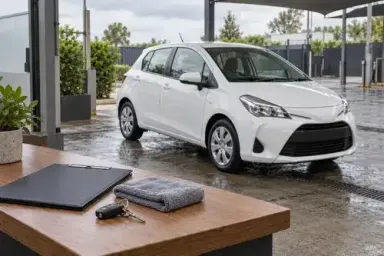

Key fob water damage happens when moisture reaches the battery contacts or the circuit board inside a remote or smart key. Remove the battery at once. Let the parts dry in open air without heat. Fit a fresh battery only when everything is fully dry. Many fobs recover, and some fail days later.
If the fob still misbehaves after that, a new battery and a second test come next. A fob that stays unreliable needs a specialist, who can supply a replacement key and program it to the car. Prevention is simpler than repair. Keep the key out of pockets, cup holders and wet areas whenever a car is being washed.
What does water do to a key fob?
A key fob holds a small circuit board, a flat button battery and a set of rubber or plastic buttons. Water attacks each part in a different way.
The battery contacts suffer first. Moisture on the metal lets current leak where it should not, and it starts corrosion. Corrosion looks like a green or white crust. It raises resistance, so even a fresh battery can deliver weak power.
The circuit board is the bigger risk. Water trapped under the chips and along the thin copper tracks can short the board while the battery is in place. Damage can also build after the fob dries. Moisture left under a component keeps eating the copper, so a fob that works on day one may fail by the next week.
Fob design changes the risk. A simple remote often has an open board and a few exposed contacts. A push-button smart key packs in more electronics, including an antenna for keyless entry, and many are sealed shut. A sealed case keeps some water out. It also stops you from drying the board.
Many fobs also hold a transponder chip. This tiny part lets the car confirm the key is genuine before the engine starts. The chip often survives water better than the remote buttons do. A fob can lose its lock and unlock function and still start the car. Treat a dead remote as a warning anyway.
The liquid matters as well. Clean rain is the mildest. Salt water, pool water, soapy water and sugary drinks leave residue that holds moisture and speeds up corrosion. Wash water usually carries soap, so a fob that gets soaked during a wash deserves extra care.
How does a key fob get wet during a wash?
Most wet fobs have an ordinary cause. These five come up again and again:
- A pocket or bag. A key in a jacket or shorts pocket gets splashed while you rinse wheels or lean over the bonnet.
- Inside the car during pressure washing. A strong jet can push water past door seals, open windows and sunroof edges. A key in a door pocket or on the dash sits in the splash zone.
- A wet cup holder. Wash days leave pooled water in cup holders and storage trays. A key dropped in there sits in moisture for hours.
- A wet surface. A key set on a damp bonnet, roof or bucket rim can slip, get hit by the hose or soak up runoff.
- Humidity. A key kept in a steamy bathroom, a damp console or a beach bag collects condensation. Humid Queensland summers make this more likely.
Handing the key to someone else adds a few more risks. The key passes through several hands, and wet hands move it. Ask where it will be kept before you leave the car.
Washing at home carries the same risks. A routine to hand wash your car effectively should start with moving the key to a dry spot, before the first bucket is filled.
What are the signs of key fob water damage?
Symptoms run from mild to total. They also overlap with a flat battery, so test the battery first. Watch for these signs:
- Shorter range, so you must stand closer to the car.
- Several presses needed before the doors respond.
- A delay between the button press and the lock.
- Some buttons that work and others that do not.
- A dash message such as "key not detected" or "low key battery". The wording varies by make.
- A remote that is dead while the car still starts, or a car that will not start with a working remote.
- Fogging inside the case, a green or white crust, or a leaking battery.
RACV lists several of these among the warning signs of a dying key battery, including needing to press a button more than once. That overlap is why a battery swap is the first test.
The pattern helps you tell the two apart. A weak battery fades slowly and behaves the same way each day. Water damage often starts right after a known soak. It can also come and go, so a fob that works one day and fails the next suggests moisture on the board.
If the fob never got wet and shows these signs, the battery is the likelier cause. A fresh battery from a trusted pack, or a fob battery borrowed from a working spare, settles the question in a minute.
What should you do straight away?
Speed matters. Work through these steps in order:
- Stop pressing buttons. A press sends current through wet circuits, which can short them.
- Remove the battery. Open the case, usually at a small slot with a coin or a flat tool. Check the owner's manual for your fob. A smart key often hides an emergency blade, so slide it out first. Discard a battery that has been soaked.
- Handle the battery safely. Follow the button battery safety guidance from Product Safety Australia. It advises changing these batteries on a flat surface away from children, and taping both sides of a used one before disposal.
- Shake out the water. Hold the open fob with the buttons facing down and tap gently. Blot the parts with a lint-free cloth.
- Keep heat away. Do not use a hair dryer, oven, microwave, radiator or sunny dashboard. Heat can warp the plastic and damage the board.
- Dry it in open air. Leave the open case parts in a dry room with some airflow for at least 24 hours. A second day is safer. Silica gel packs in a sealed box work better than uncooked rice, which absorbs slowly and can leave starch dust behind.
- Clean residue if the liquid was soapy or salty. Touch a cotton swab with a little isopropyl alcohol to any crust or film. Use a light hand and let it evaporate fully.
- Fit a fresh battery and test once. Press lock, unlock and the boot button. Then try the start function with the key inside the car.
If the car will not open or start while the fob dries, use the emergency blade to unlock the driver's door. Most push-button cars have a backup spot where a dead fob can still be read. It is often near the start button or on the steering column. Check the manual before you need it, because the location differs by make.
A dried fob can work again. The odds improve when the water was clean, the battery came out quickly and the parts dried fully. Treat a recovered fob as a loan until it proves itself. Test every function over several days.
Once the fob works, check the car's other locking functions. The car security checks after detailing cover the door latch, the boot release and the spare fob location.
A fob that works weakly after drying may only need another fresh battery. A fob that stays dead, or works only some of the time, probably has corrosion on the board.
When should you see a specialist for a water-damaged fob?
Book a specialist when the fob fails after drying and a fresh battery. The same applies to corrosion or a leaking battery, to a fob that works only sometimes, and to a sealed smart key you cannot open. More testing adds risk and delays the decision.
A specialist can do what a drying routine cannot. They can open the fob and inspect the board, test the transponder chip and cut a new emergency blade. They can also program a replacement key to the car's immobiliser. The immobiliser is the system that stops the engine starting without a recognised key. Programming usually needs diagnostic equipment connected through the car's OBD port, which is the diagnostic socket under the dash.
Auto locksmith Doncaster services cover remote replacement and key programming for drivers in Melbourne's east, which is useful when a fob cannot be revived. Wherever you live, ask whether the provider handles your make and key type before they attend.
A dealer is the other route. Dealers can supply and program keys, and some newer models restrict programming, so ask early which options your car allows. Expect to prove you own the car. Photo ID and registration papers are the usual proof.
Give the provider the facts up front. They will want:
- The make, model and year of the car.
- The key type: blade key, remote key or push-button smart key.
- What the liquid was and how long the fob stayed wet.
- Whether a working spare exists.
- What the fob does now, and what it does not do.
Plan around the spare key too. If a working spare exists, keep it dry and bring it along. A locksmith or dealer can generally copy a fob from a working key, as RACV notes. If every key is lost, the job is harder to arrange.
Make the spare early, while the damaged fob still half works. A fob that works some days will fail on the day you need it.
Are key fobs waterproof, and do water resistance claims help?
Most fobs are water resistant at best. Water resistant means the case copes with splashes. Waterproof means it survives immersion. The IP code printed on some products shows the gap. IPX4 covers splashing water. IP67 covers brief immersion in shallow water.
Many fobs list no rating at all, so check the manual before you trust a claim. A rating also describes a new, sealed case. Seals age. A fob that has been dropped, cracked or opened for battery changes may no longer meet it. A pressure washer throws a harder jet than splash tests assume.
Makers tend to be cautious. Mazda's owner's manual for the Mazda3 lists getting the key wet among the things to avoid, alongside dropping it and leaving it in high heat. That is a sensible default for any key, whatever the badge.
Add-ons help in small ways:
- Silicone covers. They add a barrier against splashes and grit. Fit one to a dry fob only, because a cover can trap moisture against the case.
- Replacement shells. A fresh shell can replace a cracked or worn case. It does not make the electronics waterproof.
- Pouches. A small sealed pouch or dry bag protects a key in a pocket or beach bag.
- Sleep or battery saving modes. Where a car offers one, it reduces battery drain. It adds no water protection.
How should you handle keys during a self-wash or hand wash?
A few habits remove most of the risk. Use these rules on wash day:
- Take the key out of every pocket before you start. Leave it somewhere dry and shaded, such as a zipped bag inside the house.
- Never leave the key on the bonnet, the roof or a bucket rim.
- Close every window and the sunroof. Keep the key out of door pockets and cup holders.
- Aim a pressure washer away from door handles, seals and lock areas.
- Dry the cup holders and trays before the key goes back in the car.
- Check the fob's battery before wash day. A weak battery makes a damp fob harder to judge afterwards.
- Store spare keys in a dry drawer, not in a bathroom, boat or damp bag.
For a hand wash service, hand over a dry key and ask where it will stay while the car is wet. When choosing a hand car wash service, ask how the team stores keys and who handles them. A clear answer is a good sign.
After any wash, test the fob once before you drive away. A problem found in the driveway is easier to fix than one found at a dark car park.
If a key does get wet at the wash, do not test it in the bay. Pull the battery before you press anything. Tell the team straight away, so you know how long the fob stayed wet. That detail helps whoever looks at the fob later.
Keep a note of the date and the cause when a fob gets wet. If it fails weeks later, that record shows whether the failure follows the soaking or has another cause.
Conclusion
Key fob water damage is easiest to manage in the first hour. Cut the power, dry the parts slowly and test a fresh battery only when nothing is damp. A fob that works again deserves a watchful week. One that fails needs a replacement programmed to the car, and a spare made while a key still works shortens that wait. Most wet fobs come from routine moments, such as a pocket, a cup holder or a hose near an open window. Moving the key somewhere dry before the wash starts removes most of the risk.